

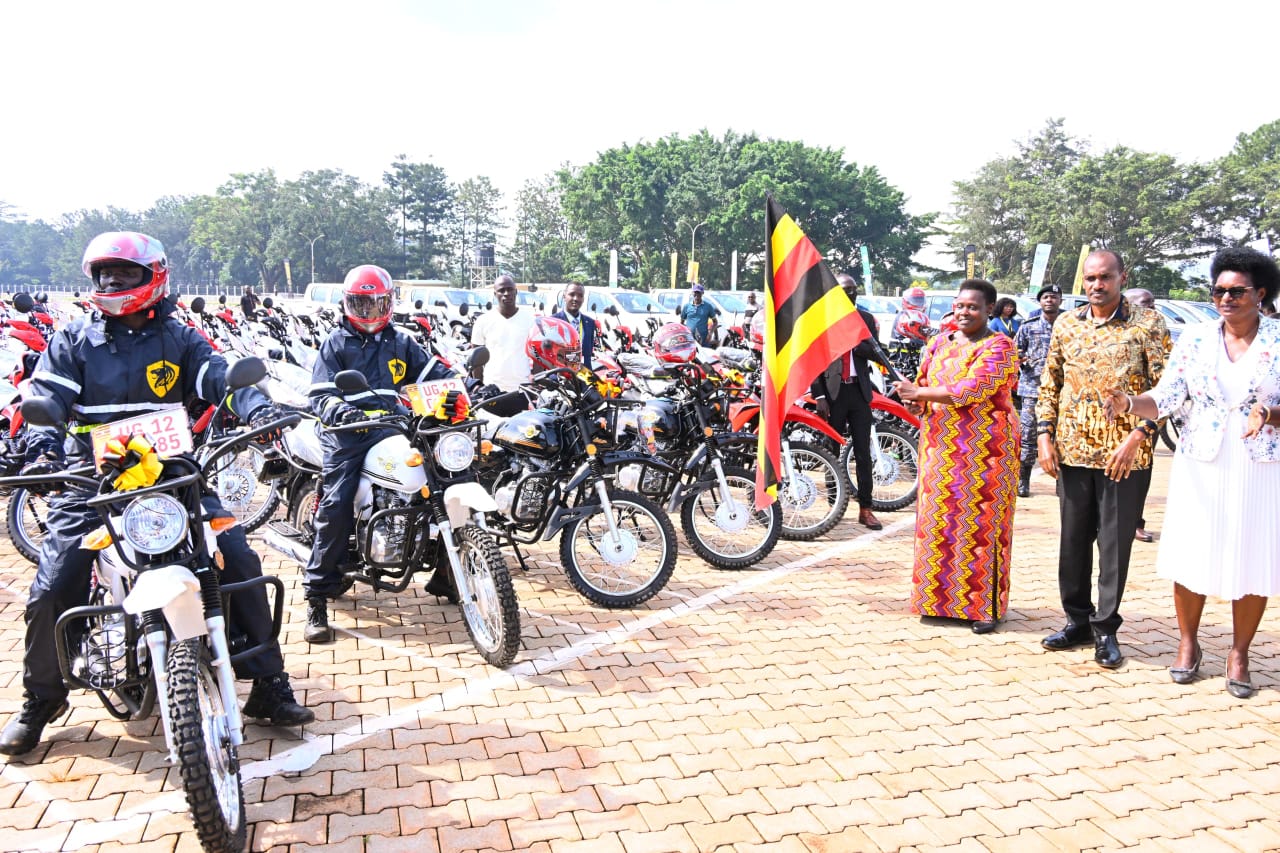
Vice President Jessica Alupo has flagged off the distribution of 109 vehicles and 1,034 motorcycles to strengthen agricultural extension services across Uganda.
The assets have been allocated to 69 districts implementing the Uganda Climate Smart Agricultural Transformation Project, with the goal of increasing productivity, improving market access, and enhancing resilience across agricultural value chains.
The six-year initiative is funded by the World Bank and implemented by the Ministry of Agriculture, Animal Industry and Fisheries.
It forms part of a broader national investment of $354 million targeting 3.9 million direct beneficiaries, including communities hosting refugees.
Speaking at the flag-off ceremony held on April 21, 2026, at Kololo Independence Grounds, Alupo described the vehicles and motorcycles as critical tools for improving service delivery to farmers.
“These vehicles and motorcycles, together with their accessories, are key tools in strengthening our capacity to deliver services to farmers, improving project implementation efficiency, and accelerating Uganda’s journey towards climate-smart agricultural transformation,” she said.
She noted that the handover fulfils the government’s commitment to equip frontline extension workers and technical teams with the mobility needed to effectively serve farmers.
“For a long time, limited mobility has constrained last-mile service delivery. These assets will enable extension staff to reach farmers more efficiently, provide timely technical support, strengthen monitoring, and enhance accountability in the use of public resources,” Alupo added.
The Vice President emphasised the need for proper management and accountability in the use of the equipment, warning against misuse.
“These are public resources entrusted to serve our farmers. They must be used strictly for official government and project activities, properly maintained, and safeguarded at all times,” she said.
She also called on all implementing agencies, districts, and stakeholders to improve coordination and accelerate execution of planned activities to ensure the project meets its objectives within the set timelines.
Alupo further urged the World Bank to sustain its support, particularly in fast-tracking the AgriConnect initiative, which is expected to unlock investments in mechanisation, irrigation, value addition, and market access.
“The success of this project depends on our collective commitment as government, development partners, and district-level implementers. Let us deliver results, transform livelihoods, and build a resilient agricultural sector,” she said.
Alupo noted that Uganda’s agriculture sector continues to register progress, particularly in employment, exports, and income generation.
She said Uganda is now Africa’s leading coffee exporter, earning approximately $2.4 billion over the past 12 months, with gains reflected in improved household incomes among coffee farmers.
On his part, the Minister of Agriculture, Frank Tumwebaze, said it remains government policy to ensure that all extension workers have adequate transport to facilitate farm outreach, advisory services, and data collection.
He called on local leaders—including Members of Parliament, LC5 chairpersons, Resident District Commissioners, District Internal Security Officers, and councillors—to ensure the equipment is properly utilised and maintained.
Tumwebaze also thanked the World Bank for prioritising agriculture in its funding framework, noting that the newly deployed vehicles and motorcycles will form the logistical backbone for field extension staff in the targeted districts.
The UCSATP is designed as a system-wide intervention addressing key constraints in Uganda’s agricultural sector, including low productivity, limited access to quality inputs, weak extension services, climate shocks, poor market linkages, and post-harvest losses.
The project also targets low mechanisation levels and the sector’s heavy reliance on manual labour by investing across the value chain in climate-smart research, improved seeds and breeds, mechanisation centres, irrigation systems, water for production, and livestock, fisheries, and aquaculture development.
Tumwebaze added that there should no longer be excuses for failing to reach farmers, urging leaders to actively support agricultural extension efforts.
He also revealed plans to establish laboratories across the country to test diseases affecting crops and livestock, as part of strengthening the sector’s resilience.
Despite ongoing challenges, the government maintains that agriculture remains on a growth trajectory, citing expanding market access and a decline in livestock diseases such as foot-and-mouth disease.
